USDCx on Aleo: The first private, programmable stablecoin | Built on Aleo


Welcome to Built on Aleo, a series spotlighting the projects and protocols building on Aleo's privacy-first infrastructure.
This edition features USDCx on Aleo, a USDC-backed stablecoin built on Aleo and launched using Circle xReserve. It's the first private, programmable stablecoin in existence, and it's available now for businesses and consumers to transact globally.
Stablecoins have changed the money transfer game
Stablecoins are a type of digital currency pegged to a stable asset, usually the US dollar. They’re designed to combine the speed and programmability of crypto with the reliability of traditional money. And, unlike volatile cryptocurrencies, their value doesn’t fluctuate.
There are big benefits to using stablecoins for money transfer: they settle in seconds, work across borders without intermediaries, and cost a fraction of the fees. If you’ve ever waited days for an international wire or paid 6% on a remittance, you’ll understand the appeal.
Since emerging in 2014, stablecoins have drastically changed how money moves. They've become the backbone of a growing onchain economy. But there's a problem that rarely gets talked about: they leak user data.
Privacy is the missing layer
On most blockchains, transactions are public by design. Sender, receiver, amount, timing, it all sits on a permanent, searchable ledger. For some use cases, that transparency is intentional, but for others, it's the one thing standing in the way of larger adoption.
Consider what it takes to run payroll onchain. Businesses need to keep salaries confidential, along with vendor relationships, supply chain financing, and treasury movements. Meeting that expectation onchain calls for privacy at the protocol level.
These aren't edge cases. They're some of the highest-value workflows that institutions want to bring onchain, and a lack of privacy is what stands between them and getting there.
The foundation is already in place. Stablecoins have reshaped how money moves, settling in seconds, crossing borders, cutting costs. Adding privacy opens the door to a much larger set of use cases: global payroll, confidential B2B settlement, private lending and more. The demand is there. What's been missing is a way to do it privately.
The cost of doing nothing
Without privacy, critical financial workflows, the type institutions run, stay on legacy rails. Global payroll continues to move through banks. Supply chain payments stay in SWIFT. Confidential lending stays off the ledger.
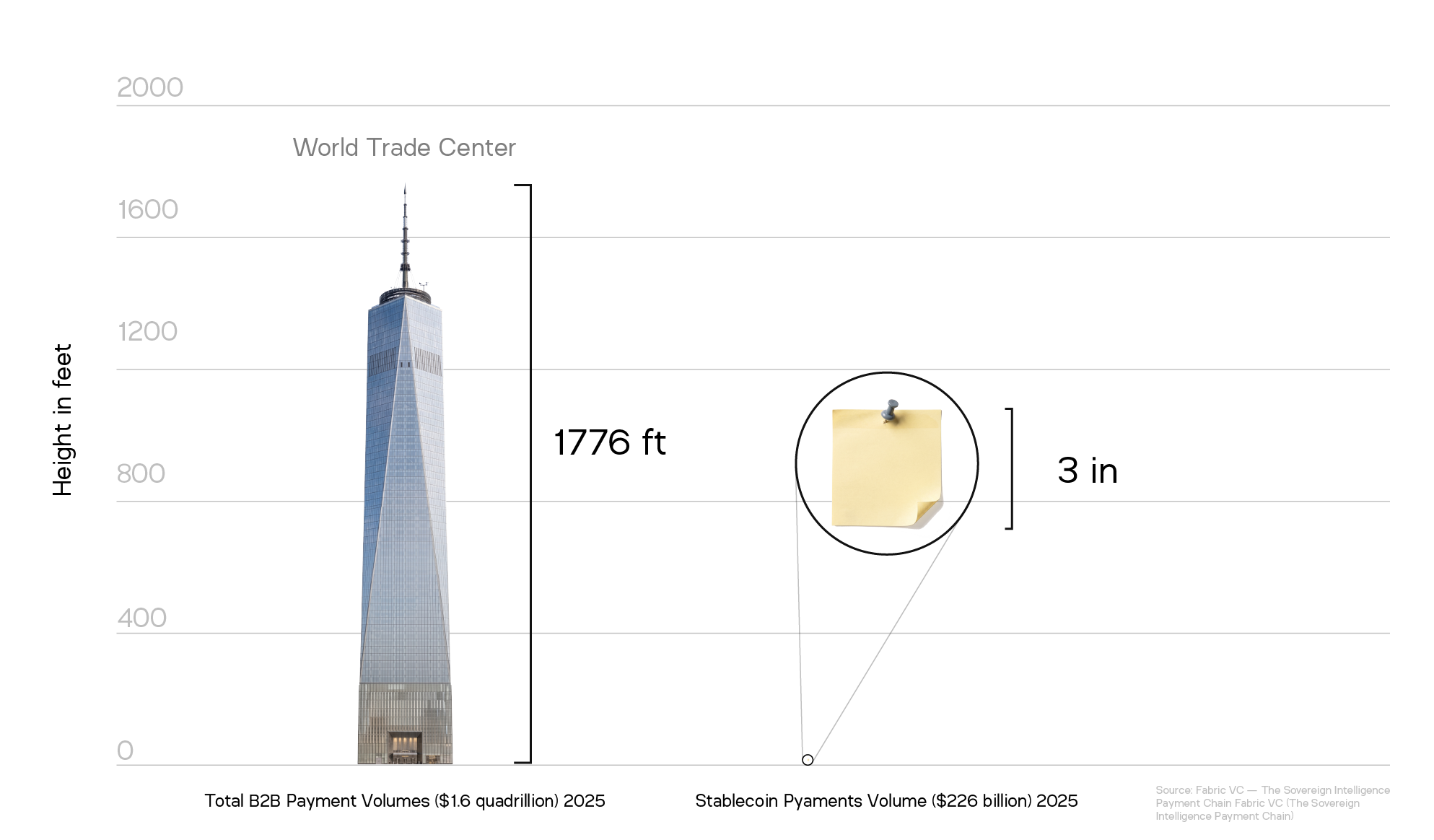
The payments industry generates $2.5 trillion in revenue from $2.0 quadrillion in value flows, much of it B2B, but very little of that will touch blockchains in the current paradigm. Not because the technology isn't fast enough, but because it isn't private enough.
There's also a more immediate risk: public transaction histories create real-world exposure.
Counterparties can track a company's cash position, employees can infer each other's compensation, and aid organisations operating in conflict zones can inadvertently reveal recipient identities. The transparency that makes blockchains trustworthy for some use cases, makes them dangerous for others.
The longer this problem goes unsolved, the longer stablecoins fall short of their full potential in the global financial system.
Enter Aleo: the privacy layer stablecoins were missing
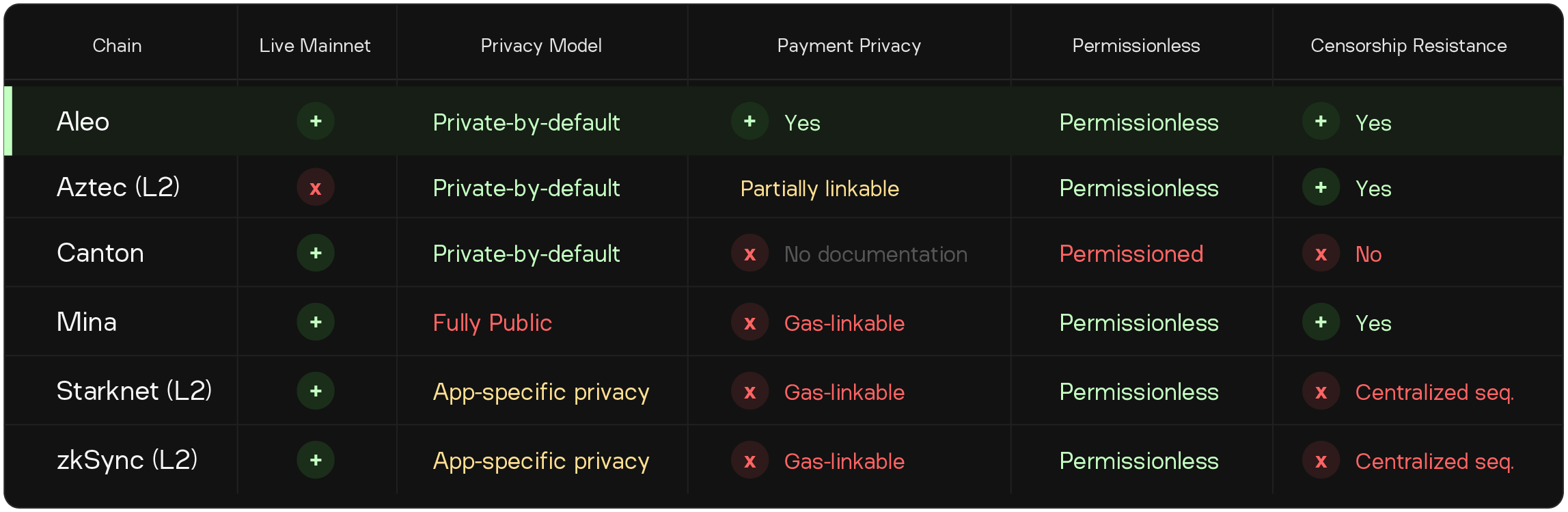
Aleo is a Layer 1 blockchain, built from the ground up for private, programmable applications. At its core is zero-knowledge proof technology, cryptographic machinery that lets the network verify transactions are valid without revealing the underlying data.
On Aleo, balances stay hidden. Counterparties remain private. Transaction amounts are encrypted. This all happens onchain, without relying on off-chain workarounds or trusted intermediaries.
What makes Aleo different is this private programmable design. Every application built on Aleo can inherit it. This empowers the business leveraging it to select what financial workflows are made public and to who.
It’s this underlying infrastructure that makes USDCx on Aleo so powerful.
How USDCx on Aleo works
USDCx on Aleo is a USDC-backed stablecoin, deployed on Aleo using Circle xReserve, a smart contract infrastructure developed by Circle that enables blockchains to issue native, USDC-backed assets without relying on third-party bridges.
The mechanics are straightforward: for every USDCx minted on Aleo, an equivalent amount of USDC is locked in a smart contract on Ethereum. Users can move freely between USDCx on Aleo and USDC on supported chains through Circle's Cross-Chain Transfer Protocol (CCTP) and Gateway infrastructure, without touching external bridging services.
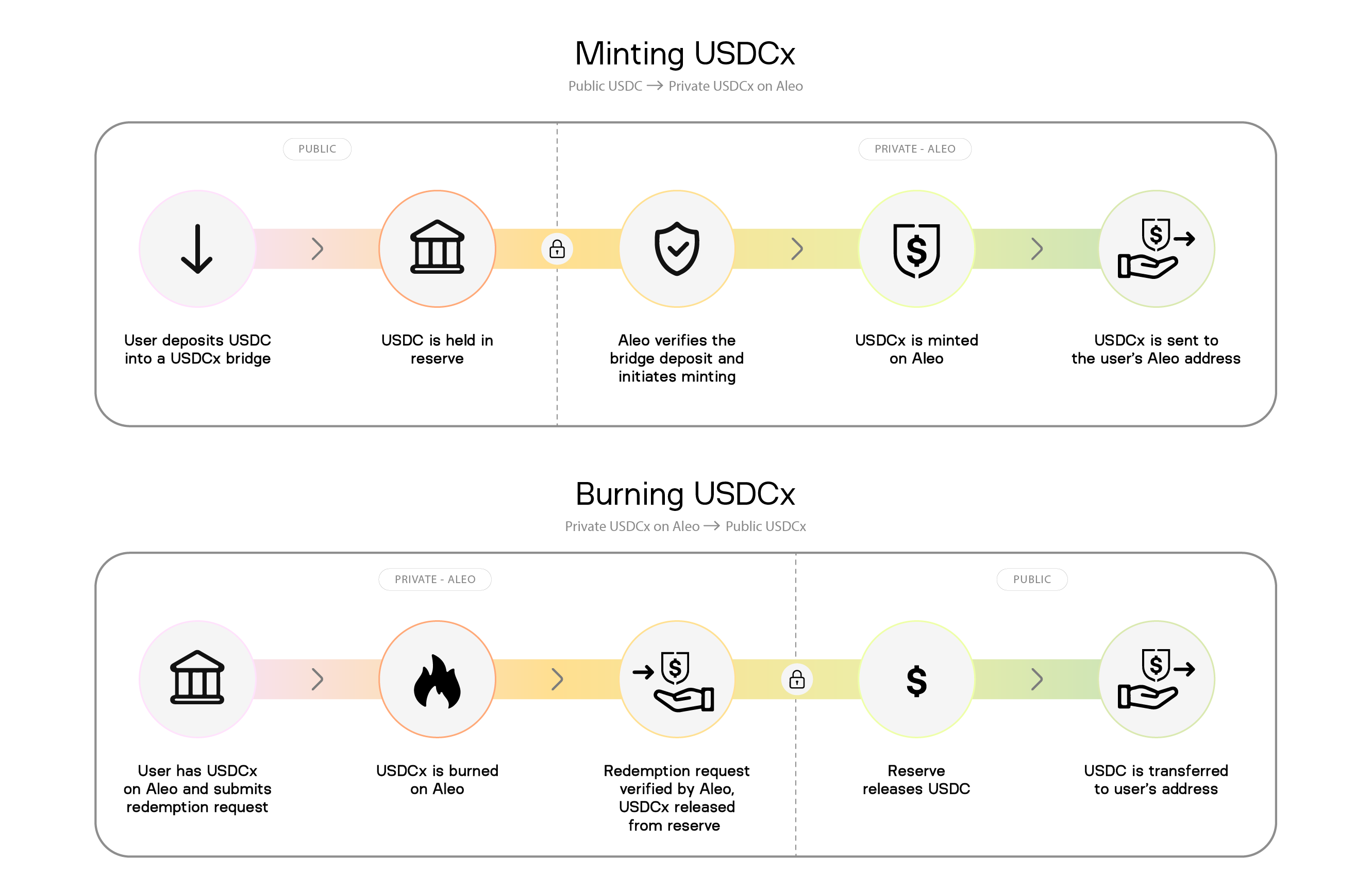
The result is a stablecoin that combines two things that have never existed together before:
- The liquidity of USDC, the world's most widely used, regulated digital dollar.
- The privacy guarantees of Aleo's zero-knowledge infrastructure.
Transaction details, such as sender, receiver, amount, are encrypted by default. It's also programmable, so developers can build applications on top of USDCx.
Private payroll contracts, confidential lending pools, DeFi protocols with privacy at the settlement layer, all of this is possible using the Leo programming language on Aleo. The privacy isn't just for transfers, it extends to whatever logic you build within your applications.
Unlock a world of financial possibilities & efficiencies
USDCx on Aleo enhances the following categories of financial applications.
- Global payroll: Distribute salaries to teams worldwide, without revealing compensation structures publicly or creating personal security risks for employees.
- Private B2B payments: Settle vendor invoices and supply chain transactions onchain without exposing pricing, contract terms, or commercial relationships to competitors.
- Critical aid distribution: Deliver funds to vulnerable populations without exposing recipient identities or putting individuals at risk.
- P2P payments and remittances: Send money internationally with the privacy of cash and the reach of a digital dollar.
- Private DeFi: Give developers access to dollar-denominated liquidity with programmable, application-layer privacy.
Get Started With USDCx on Aleo
Explore USDCx on Aleo at aleo.org/usdcx. You can mint USDCx directly at usdcx.aleo.org.
If you're a developer interested in building private financial applications on top of USDCx, explore Aleo's developer documentation and the Leo programming language.
Follow Aleo on X: @AleoHQ | Join the Discord: discord.gg/aleo