Stablecoin Privacy: A New Paper Making The Case for Private Stablecoins


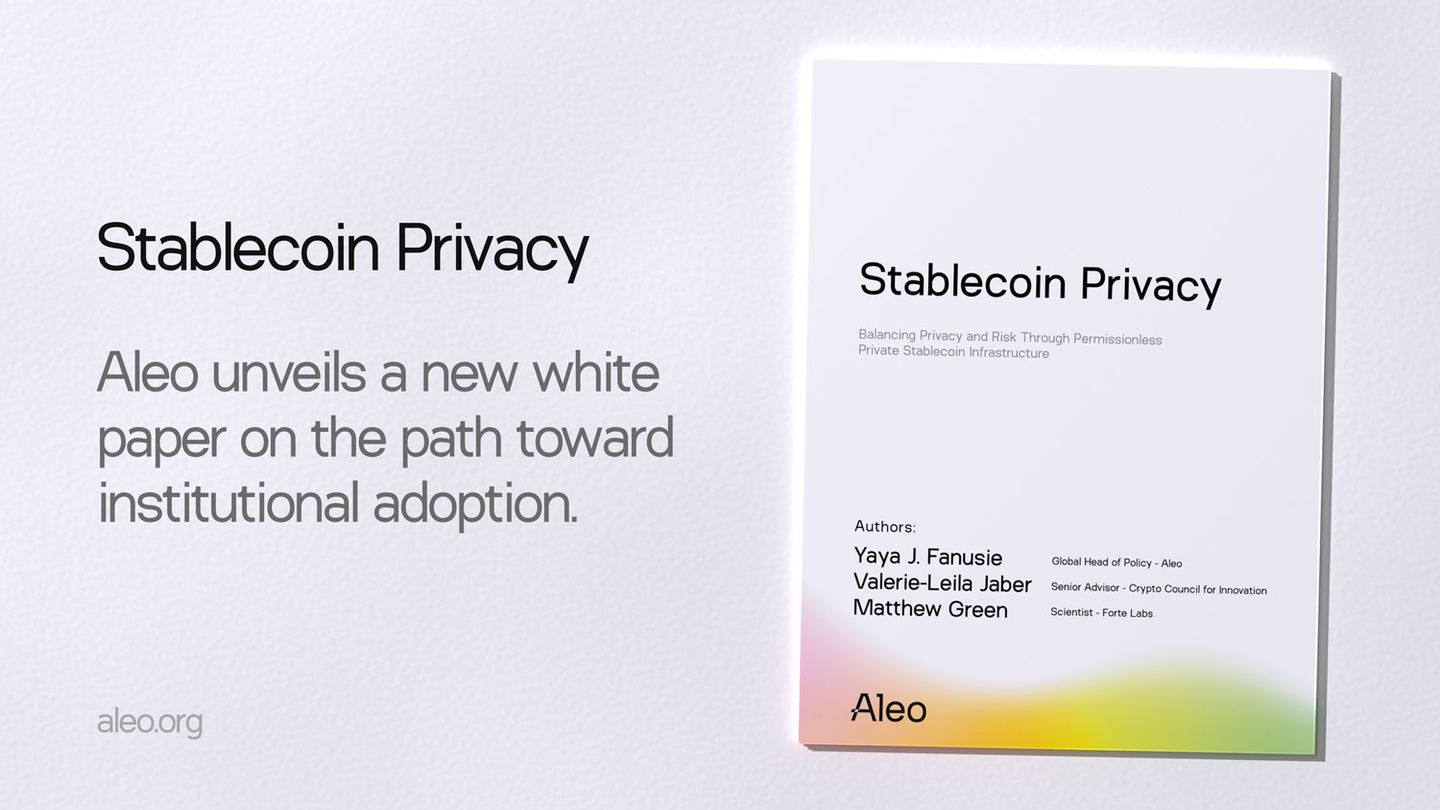
The case for private stablecoins has never been stronger. Today, we're releasing a landmark white paper that explains how privacy is the missing layer for bringing onchain finance up to institutional standards.
Behind this paper is a team that has spent careers at the intersection of cryptography, policy, and financial systems. Yaya J. Fanusie, Aleo's Global Head of Policy, Valerie-Leila Jaber of the Crypto Council for Innovation and former Global Head of Financial Crime Compliance at Coinbase, and Matthew Green, cryptographer and Johns Hopkins University computer science professor, bring a rare combination of hands-on experience in private payments, financial regulation, and zero-knowledge cryptography. Their findings mark a significant moment, not just for Aleo, but for institutional finance as a whole.
Read the full white paper.
The problem with public blockchains
The GENIUS Act has opened the door to widespread stablecoin adoption. But there's a structural problem standing in the way: public blockchains expose every transaction, permanently, to anyone on the internet.
Payroll. Treasury operations. Vendor payments. All of it broadcast to the world.
When your payroll goes onchain, your employees' salaries become public information. When you manage treasury operations, your competitors get a full view of your financial position. Neither is acceptable, and it's the reason institutional adoption has stalled.
When payroll goes onchain, salaries become public. When aid organizations move funds, recipient identities are exposed. When defense teams settle payments, operational security is at risk. For institutions where privacy is a requirement, public blockchains simply don't work.
Why existing solutions fall short
The industry has tried to solve this. Existing privacy alternatives struggle to solve this problem at scale, either by lacking meaningful risk mitigation, carrying prohibitive regulatory stigma, or sacrificing the permissionless access that makes blockchain payment rails commercially viable.
The industry has been stuck, but today that changes.
Aleo's solution: private by default, programmable by design
This paper presents a new path: permissionless private stablecoin architecture built on Aleo, using zero-knowledge proof technology and programmable smart contracts. Financial privacy and institutional risk management are not in tension. On Aleo, they're built from the same foundation.
And it's already working in practice. Aleo is supporting private stablecoin aid to displaced communities in Colombia, global payroll is live through Toku and Paxos Labs, and Aleo is the first blockchain to support fully private transactions on Ledger hardware wallets. The infrastructure described in this paper isn't hypothetical, it's already being used in the field.
Balancing privacy and risk
The paper presents three interlocking building blocks that give institutions the tools to meet their risk management obligations, without compromising user privacy:
- ComplianceRecords: Every private transaction emits an encrypted record, decryptable only by a designated RiskManager. Full visibility for risk monitoring, zero public exposure.
- Freeze List: An onchain address restriction mechanism checked on every transaction. Institutions can immobilize flagged addresses in real time.
- Bridge Controls: Every mint requires cryptographic issuer authorization. Every burn runs through the same freeze check. The off-ramp is a hard enforcement point.
By combining these features, legitimate users get genuine privacy protections, while also ensuring the system remains resistant to bad actors.
Private stablecoins are ready for mainstream finance
Public blockchains are not viable for mainstream institutional payments. Existing privacy solutions carry too much regulatory risk or too little functionality. Aleo's permissionless, private stablecoin architecture is the missing layer the industry has been waiting for.
Privacy isn't a feature. It's the foundation that makes institutional adoption of onchain finance possible. The technology is ready. The regulatory conversation is happening. This paper makes the case for why institutions, issuers, and regulators should engage now.