Toku: The company that made private stablecoin payroll a reality | Built on Aleo


Welcome to Built on Aleo, a series spotlighting the projects and protocols building on Aleo's privacy-first infrastructure.
This edition features Toku, payroll and employment infrastructure for the stablecoin economy. They set out to make stablecoin payments work for real enterprises, and hit a wall that the entire industry had quietly agreed to ignore. The problem wasn't technical. It was privacy. In this piece we’ll break down how Toku found a solution in private stablecoins.
This enabled private stablecoin payroll, which lets companies pay global teams in stablecoins without exposing salaries, bonuses, or treasury movements on a public ledger. Toku and Aleo launched the first production implementation in January 2026.
The wall every enterprise hits
The numbers look like a technology success story. In 2025 alone, stablecoins processed over $33 trillion in transactions, eclipsing the combined annual volume of Visa and Mastercard. Adoption is accelerating, developer tooling is maturing, and regulatory clarity is improving.
Despite that, less than 1% of businesses use crypto for payroll. The world's $55 trillion global payroll market has remained almost entirely offchain.
Toku was built to close that gap. The company operates in more than 100 jurisdictions, handling employment contracts, tax obligations, statutory benefits, and regulatory filings. It integrates directly with the payroll systems enterprises already use (ADP, Workday, UKG, Gusto, etc.) via a seamless API. By every measure, it had built the infrastructure needed to make stablecoin payroll viable.
But infrastructure alone wasn't enough.
“Compliance was never the blocker, we solved that in 100-plus countries. The blocker was every salary sitting on a public ledger. Aleo now handles that.”
— Ken O’Friel, CEO, Toku
The constraint was simple, and a dealbreaker. On most blockchains, every transaction is public by default. Sender, receiver, amount, timestamp: all of it sits on a permanent, searchable ledger. For payroll, that means every employee's salary is visible to their colleagues, every bonus is a matter of public record, and every treasury movement can be read by competitors.
It's how public blockchains work by design, not an edge case or potential scenario. And it's why enterprise adoption of stablecoin payroll had stalled: not from lack of interest, but from an absence of privacy.
What staying on legacy rails actually costs
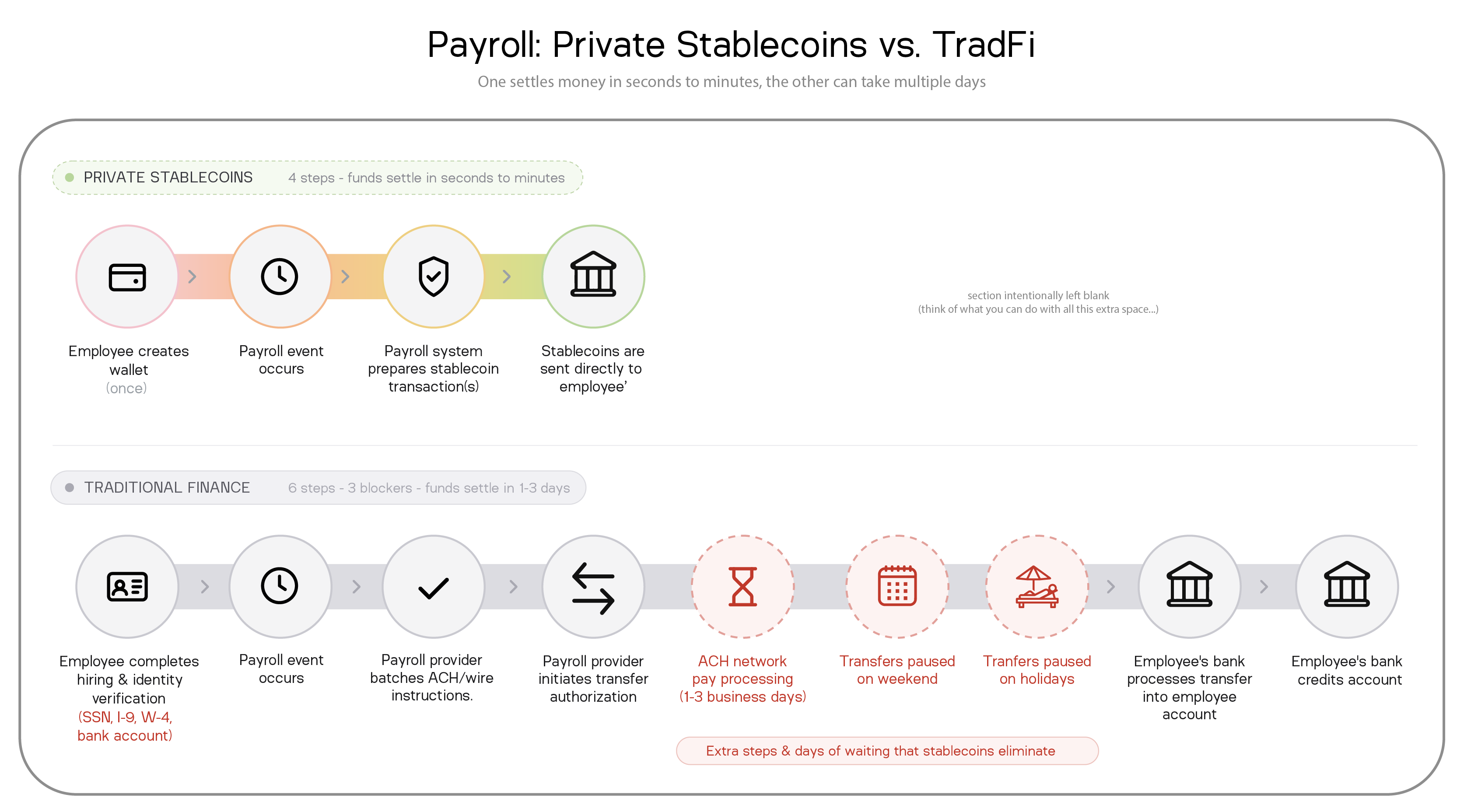
For companies with globally distributed teams, traditional international payroll is neither simple nor cheap. Cross-border wire transfers carry high fees, take days to settle, and involve currency conversion risk at every step. The banking infrastructure simply wasn’t built for the pace of modern, distributed work.
The irony is that blockchain-based payroll was supposed to solve exactly this, with instant settlement, lower fees, and dollar-denominated stability for employees anywhere in the world. The technology worked, the economics made sense, and the compliance infrastructure — Toku's core product — was ready.
But there was no privacy. And because of that, the promise of onchain payroll remained theoretical, while companies continued to absorb the costs and friction of legacy rails.
Unlocking a $55 trillion opportunity
The global payroll market is worth $55 trillion annually. Despite years of stablecoin innovation, fewer than 1% of businesses use crypto for payroll. The barrier isn't infrastructure — it's privacy.
Enter Aleo: privacy by design
Aleo is a Layer 1 blockchain built from the ground up for private, programmable payment applications. At its core is zero-knowledge proof technology: cryptography that lets the network verify a transaction is valid without revealing the underlying data. Balances stay hidden, counterparties remain confidential, and transaction amounts are encrypted. Not as a workaround, but as the default.
This is the distinction that matters. Most privacy tools in blockchain are layered on top of an existing transparent system. They're opt-in, imperfect, and often introduce their own compliance complications. Aleo's privacy is structural, and every application built on it automatically inherits the same guarantees.
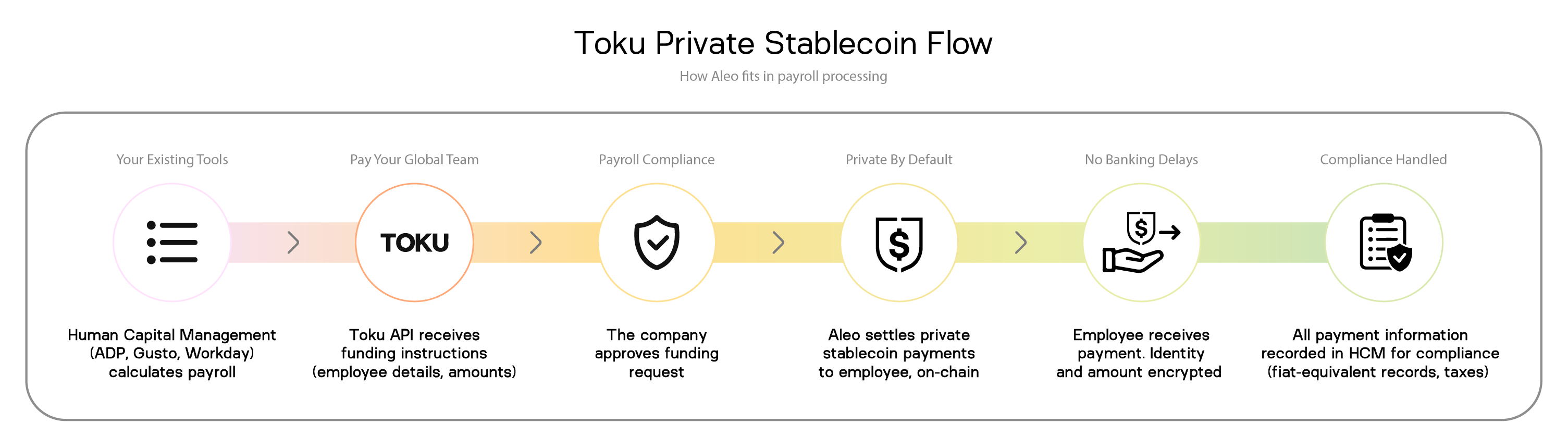
Toku's integration with Aleo works because the two products complement each other precisely. Toku handles everything above the settlement layer: employment contracts, tax withholding, statutory filings, and multi-jurisdiction compliance. Aleo handles everything below it: private, verifiable, onchain settlement.
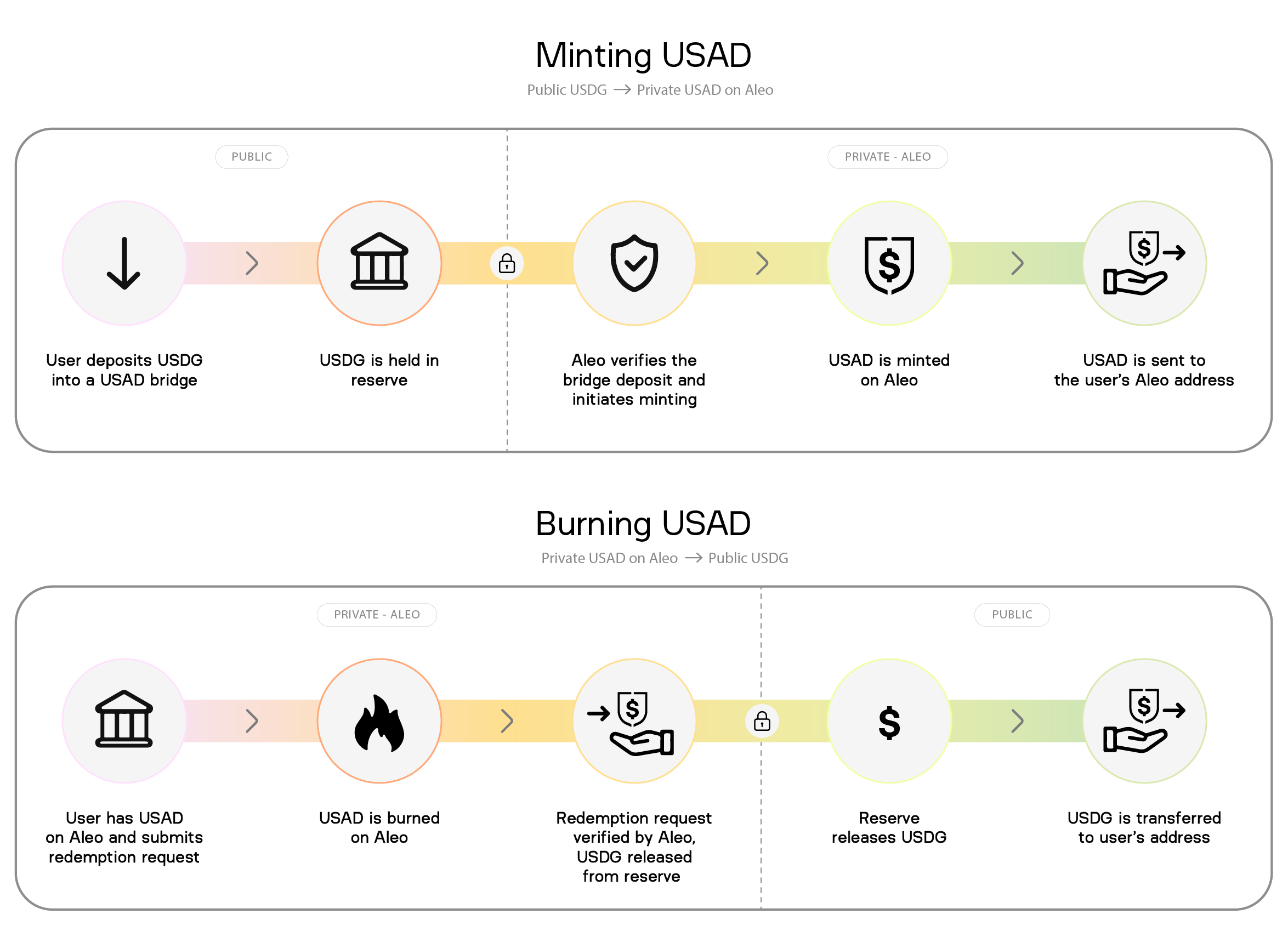
USAD is the connector between Toku and Aleo. It’s a US dollar-pegged stablecoin issued by Paxos Labs on the Aleo network, backed 1:1 by USDG (a reserve token issued by Paxos Trust Company and held in segregated, bankruptcy-remote accounts).
"Privacy is the missing link in blockchain adoption at scale, and with USAD we are proving it can exist in a programmable stablecoin."
— Leena Im, Executive Director, The Aleo Network Foundation
Payroll funds flow into Toku's platform, compliance is handled in the existing HR stack, and settlement happens privately on Aleo. Employees receive their salaries in USAD. No salary information is visible onchain, and treasury movements stay hidden.
How USAD is backed
USAD is a US dollar-pegged stablecoin issued by Paxos Labs on Aleo’s zero-knowledge blockchain. It’s backed 1:1 by USDG, the reserve token of Global Dollar Network, which is issued by Paxos Trust Company and held in segregated, bankruptcy-remote accounts backed by US dollar deposits and short-term US Treasury securities.
Live before launch: the internal proof
Before offering private stablecoin payroll to enterprise clients, both Aleo and Toku used the system to pay their own teams. Employees and contractors spread across North America, Europe, and Asia could opt in to receive their salaries in USAD, with instant access to dollar-denominated currency, while retaining their personal financial privacy.
Lots of blockchain innovation exists as proof of concept. Toku's private stablecoin payroll was used in production, by the companies who built it, before anyone else was asked to rely on it.
What Toku + Aleo makes possible
The Toku–Aleo integration is the first real-world implementation of private stablecoin payroll. But the same infrastructure protects more than the payroll run itself, extending confidentiality to the broader financial operations tied to it, because privacy was always the missing piece.
- Confidential payroll: Pay a global workforce in stablecoins without exposing salaries, bonuses, or compensation structures to colleagues or competitors.
- Private treasury management: Move corporate reserves and fund payroll operations onchain without exposing burn rate, vendor payments, or treasury movements to public view.
- Employee and executive protection: Shield high-profile employees and contractors, especially those in sensitive regions, from being targeted based on visible wallet balances.
- Audit-ready by design: Keep a complete, exportable payroll record for tax and compliance, even though the public ledger reveals nothing.
- Lower workflow integration friction: Plugs directly into Workday, ADP, and SAP. No need to change existing workflows.
In all these use cases, compliance and privacy coexist by design. Aleo's zero-knowledge architecture lets participants cryptographically prove they've met regulatory requirements without exposing the underlying transaction data.
"For stablecoins to move beyond experimentation, they need to fit into real business workflows. Privacy is becoming table stakes for enterprise adoption."
— Bhau Kotecha, Co-founder, Paxos Labs
Get started with private stablecoin payroll
Private stablecoin payroll through Toku and Aleo is live today.
- Learn more about what Toku can unlock for your organization at toku.com.
- Enterprises looking to modernise global payroll infrastructure can book a demo.
- Developers interested in building private financial applications on top of USAD can explore Aleo's developer documentation and the Leo programming language.
- Learn more about USAD and the broader ecosystem at aleo.org/usad.
Follow Aleo on X: @AleoHQ | Join the Discord: discord.gg/aleo