Private Stablecoin Payments for Public Good: Labrys & Aleo


For professional, enterprise and public-sector audiences. Not directed at UK retail consumers.
Labrys and Aleo demonstrate encrypted USDCx payments for crisis response and humanitarian operations — an early proof point for a broader platform roadmap that includes the USDCx Card programme.
Stablecoins have proven that money can move globally with internet speed. But many real-world payment flows cannot happen on fully transparent rails.
Today, most stablecoin transactions occur on public blockchains where amounts, counterparties, timing, and wallet relationships can be observed by anyone. That level of visibility is unsuitable for most government, humanitarian, enterprise, and personal payments.
Most organisations will not run payroll, supplier networks, treasury operations, crisis response, or sensitive cross-border payments on systems that expose their financial relationships by default. For stablecoins to reach broader real-world adoption, digital payments need the privacy of traditional banking with the speed, cost, and usability of modern blockchain infrastructure.
Labrys Technologies and Aleo have demonstrated one step towards that future: encrypted USDCx stablecoin payments on Aleo mainnet.

The Demonstration
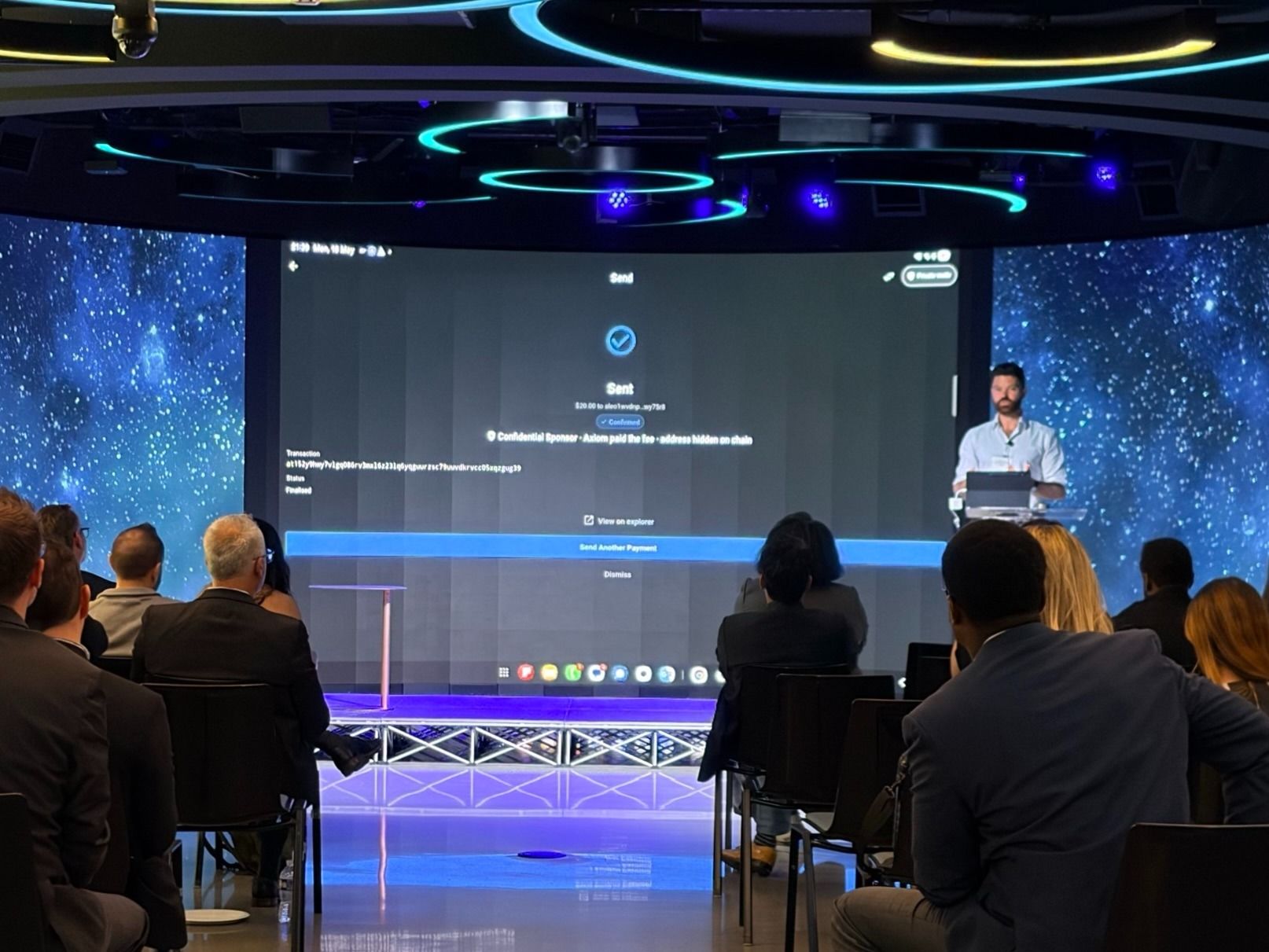
On 18 May, at From Checkout to Cross-Border: Re-Architecting Payments for a Digital Economy — an invite-only Booz Allen × a16z event in Washington, DC — Labrys and Aleo demonstrated a mainnet-proven encrypted USDCx payment for crisis response and humanitarian operators.
The session opened with a panel on the modern payment stack featuring Aleo, Anchorage Digital, Moov, and TRM Labs, with Booz Allen and a16z co-hosting. Labrys then delivered the live demonstration.
The payment settled in USDCx on Aleo — a private, programmable, dollar-denominated stablecoin backed 1:1 by USDC held in Circle xReserve and freely convertible to USDC across supported chains.
The demonstration used a Labrys-built capability called Confidential Sponsor, which allows a payment to remain verifiable on-chain while keeping the sender, recipient, and fee sponsor private.
Why This Matters
In crisis response, humanitarian operations, and other sensitive workflows, public exposure of payment details can create operational, commercial, or personal risk.
Crisis response and humanitarian operations are often conducted in unstable, high-risk geopolitical environments where the threat of violence is real. The same instruments the financial-crime community uses to track illicit flows can be turned against legitimate users. Cluster analysis on humanitarian payment flows can threaten the lives of the very people the operation is intended to support.
Private stablecoin payments allow organisations to benefit from fast, programmable settlement without making sensitive financial relationships visible to the entire world.
Chain-level analysis is one front of a broader threat picture. The next wave — AI-augmented intercept of messaging, generative manipulation of media, identity spoofing at scale, chain-level analysis of payment flows — cannot be solved at any single point. It reaches across the whole platform, and the cryptographic discipline required to defend against it has to do the same.
What Labrys and Aleo Each Bring
Labrys builds Axiom — a mobile-first platform that brings together encrypted messaging, verified media, private stablecoin payments, and a growing range of operational modules under a single cryptographic assurance framework. Axiom is built for the coordination challenges of distributed civilian, governmental, humanitarian and operational networks where conventional infrastructure falls short.
Across 2026, Axiom is rolling out a series of cryptographic trust upgrades — operational modules, payments and the wider platform architecture. The work demonstrated here is one of them.
Aleo provides the privacy-preserving blockchain infrastructure behind the demonstration. Aleo's programmable architecture allows builders to protect sensitive payment details by default, while designing applications with the controls their users and operating environments require. What is removed is the indiscriminate public visibility that a humanitarian payment never needed to surrender to begin with.
What's Next
The Washington, DC demonstration is part of a broader Labrys platform roadmap. The next phase includes the USDCx Card programme, multi-currency stablecoin capabilities across sterling and euro rails, and additional private payment products for government, enterprise, and humanitarian operators.
The next phase of stablecoin adoption will not be defined by speed alone. It will be defined by whether stablecoins can support real-world payment flows without forcing sensitive financial relationships into public view.
The Labrys and Aleo demonstration shows that private stablecoin payments are no longer theoretical. They can be built, verified, and deployed on mainnet today. Private payments are one facet of what Axiom is being built into; the broader platform — and the coordination architecture it implies for the institutions that will increasingly need to operate together at scale — is what Labrys is building towards.
For on-chain proof artefacts, the technical brief, or a conversation about how encrypted USDCx payments compose into the broader Labrys roadmap, contact press@labrys.tech.
For Aleo enquiries, contact press@aleo.org.
About Labrys
Labrys Technologies builds Axiom, the mobile operations platform used by defence, logistics and humanitarian teams in environments where consumer-grade infrastructure is unreliable, hostile or absent. Axiom brings encrypted messaging, cryptographically verified imagery and integrated stablecoin payments into a single application. Founded by veterans of the Royal Marines, the British Army and UK Government, alongside a team of cryptographic, identity and trust engineers. Headquartered in London. Series A led by Plural (Platform), backed by Albion VC and Project A Ventures. Learn more at labrys.tech.
About Aleo
Aleo is a privacy-preserving Layer-1 blockchain enabling fully programmable zero-knowledge applications at scale. Aleo supports a growing ecosystem of regulated and privacy-by-default applications across financial services, identity and verifiable compute. Its growing list of partners includes Circle, Paxos Labs, Google Cloud, Revolut, Toku, Worldpay, and the Global Dollar Network to scale encrypted stablecoin payment solutions globally. Learn more at Aleo.org
Note - This release describes a capability demonstration and the planned Axiom platform roadmap. Labrys currently provides Axiom on a non-custodial basis to enterprise customers; customer-facing capabilities described above are subject to the necessary regulatory and partner authorisations. This release is not directed at retail consumers and does not constitute a financial promotion.